
VOID AGREEMENTS AND QUASI-CONTRACTS
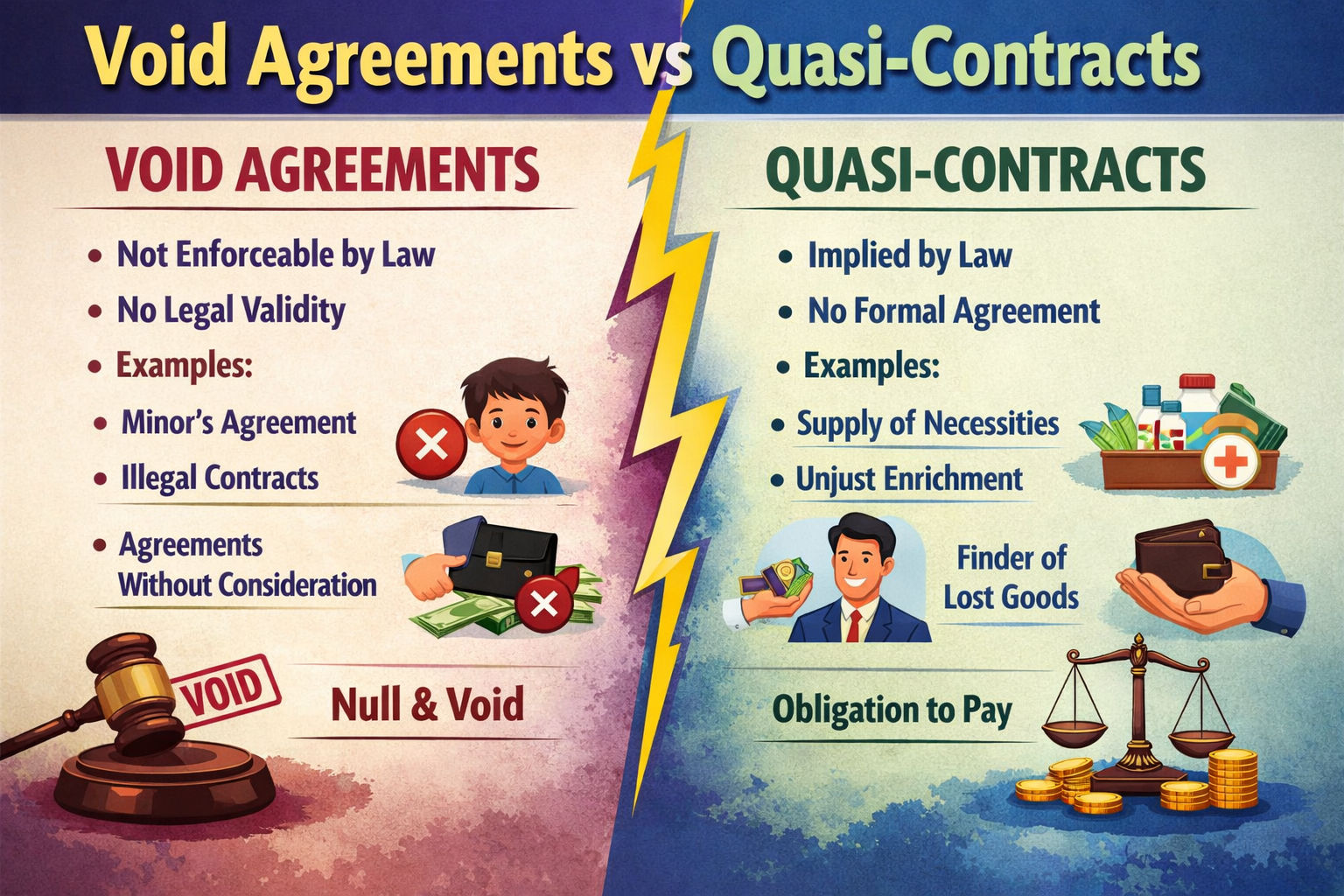
In the intricate world of contracts, not all agreements are created equal. While some form the bedrock of legal enforceability, others are, from the very beginning, destined to be legally meaningless. This brings us to two crucial, yet distinct, concepts under the Indian Contract Act, 1872: Void Agreements and Quasi-Contracts.
Understanding the difference between an agreement that is “void” (meaning it never truly existed in the eyes of the law) and a “quasi-contract” (where the law steps in to create an obligation even without an agreement) is fundamental for anyone navigating the legal landscape of India.
1. Void Agreements: Agreements with No Legal Effect (Section 2(g) & 2(j))
An agreement which is “not enforceable by law is said to be void” as per Section 2(g) of the Indian Contract Act. This means that such an agreement has no legal standing; it creates no rights or obligations for either party. It’s as if the agreement never happened. A void agreement is void ab initio, meaning it’s void from the very beginning.
It’s important to differentiate this from a voidable contract (Section 2(i)), which is initially valid but can be set aside by one of the parties due to lack of free consent (e.g., coercion, fraud).
Key Reasons an Agreement Might Be Void:
- Agreements by Incompetent Parties (Section 11): As established in Mohori Bibee v. Dharmodas Ghose, agreements with minors, persons of unsound mind, or those disqualified by law are void ab initio.
- Agreements Made Under Mutual Mistake of Fact (Section 20): If both parties are mistaken about a fundamental fact essential to the agreement, it is void.
- Agreements with Unlawful Object or Consideration (Section 23): If the purpose of the agreement or the consideration involves something illegal, immoral, or opposed to public policy, it is void.
- Agreements Without Consideration (Section 25): Generally, a promise without ‘something in return’ (consideration) is void, with a few exceptions (e.g., natural love and affection).
- Agreements in Restraint of Marriage (Section 26): Any agreement preventing a major person from marrying is void.
- Agreements in Restraint of Trade (Section 27): Agreements that restrict a person from carrying on a lawful profession, trade, or business are generally void.
- Agreements in Restraint of Legal Proceedings (Section 28): Agreements that completely bar a party from enforcing their rights through legal proceedings are void.
- Agreements the Meaning of Which is Uncertain (Section 29): If the terms of the agreement are vague or cannot be made certain, it is void.
- Wagering Agreements (Section 30): Agreements by way of wager (betting) are void and generally cannot be enforced, though certain horse race competitions are an exception.
- Agreements to do Impossible Acts (Section 56): An agreement to do an act impossible in itself (e.g., ‘A’ agrees to discover treasure by magic for ‘B’) is void.
Consequence: When an agreement is void, neither party can compel the other to perform, nor can they claim damages for non-performance. Any money or benefit transferred under a void agreement might be recoverable under specific provisions, often touching upon principles similar to quasi-contracts.
2. Quasi-Contracts (Section 68 to 72): Obligations Resembling Contracts
Unlike void agreements, which lack legal enforceability, Quasi-Contracts (or ‘certain relations resembling those created by contract’) are not contracts in the true sense. They arise not from an offer and acceptance, but are imposed by law to prevent unjust enrichment—meaning one party unfairly benefiting at the expense of another.
The law creates these obligations as if there were a contract, even when there isn’t one. The underlying principle is equity and justice.
Types of Quasi-Contracts under Indian Law:
- Supply of Necessaries to Persons Incapable of Contracting (Section 68): If a person incapable of entering into a contract (e.g., a minor, a person of unsound mind) is supplied with necessaries suited to their condition in life, the person who supplied them can be reimbursed from the property of such incapable person.
- Example: ‘A’ supplies ‘B’ (a lunatic) with necessaries. ‘A’ can claim the cost from ‘B’s property.
- Payment by an Interested Person (Section 69): A person who is interested in the payment of money which another is bound by law to pay, and who therefore pays it, is entitled to be reimbursed by the other.
- Example: ‘A’ leases land from ‘B’, a Zamindar. ‘B’ fails to pay the government revenue, and the land is advertised for sale. ‘A’, to prevent the sale of his leasehold, pays the government. ‘A’ can recover the amount from ‘B’.
- Obligation of Person Enjoying Benefit of Non-Gratuitous Act (Section 70): Where a person lawfully does anything for another person, or delivers anything to him, not intending to do so gratuitously (i.e., not for free), and such other person enjoys the benefit thereof, the latter is bound to make compensation to the former.
- Example: ‘A’, a tradesman, leaves goods at ‘B’s house by mistake. ‘B’ treats the goods as his own. ‘B’ is bound to pay ‘A’ for them.
- Responsibility of Finder of Goods (Section 71): A person who finds goods belonging to another, and takes them into his custody, is subject to the same responsibility as a bailee. The finder must take reasonable care, try to find the true owner, and not appropriate the goods for personal use. If the owner is found, the goods must be returned.
- Example: ‘A’ finds a diamond ring on the road. ‘A’ must try to find the owner. If ‘A’ sells it, he is liable to the true owner.
- Money Paid by Mistake or Under Coercion (Section 72): A person to whom money has been paid, or anything delivered, by mistake or under coercion, must repay or return it.
- Example: ‘A’ and ‘B’ jointly owe ‘C’ Rs. 100. ‘A’ alone pays the amount to ‘C’, and ‘B’, not knowing this fact, also pays Rs. 100 to ‘C’. ‘C’ is bound to repay the amount to ‘B’.
Consequence: In quasi-contracts, the law imposes an obligation on one party to pay the other, thereby preventing a situation where one party benefits unfairly. The remedy is typically financial compensation.
Conclusion
Void agreements and quasi-contracts represent two sides of the same legal coin: what happens when a traditional, enforceable contract is absent. Void agreements are dead on arrival, creating no legal ties. Quasi-contracts, on the other hand, are the law’s way of ensuring fairness and justice, stepping in to create a legal bond where a real contract never existed, purely to prevent unjust enrichment. Understanding these nuances is key to navigating the complexities of agreements and obligations under Indian law.
Comments 0